When everything feels disconnected

Helping mid- and late-stage qualitative PhD students make sense of the mess and keep moving forward.

Helping PhD researchers doing qualitative studies navigate their way through the messy realities of researching the human experience.

The further you get into a qualitative PhD study, the messier it gets.

You go from starting your PhD - where you know this research is going to be tough, but you’re excited about it – to knee deep in complexity wondering, “What on earth is going on here?”.  

Cue chapter rewrites, paranoia you’ve missed a crucial piece of literature or fundamentally misunderstood an important theory. You write thousands of words, then delete some of them, then try to retrieve them six months later from a file called FinalVersion4a_USETHISONE.

You might be worrying these are big red flags telling you that your PhD work isn’t good enough.

They’re actually completely normal phases of a qualitative research study.

Qualitative research at PhD level is layered, complicated, iterative and slippery. It’s supposed to proceed in a non-linear, looping, back-and-forth kind of way. In fact, I’d worry if your research didn’t look like this.

I’m Dr Eizabeth Yardley and I’ve spent 20 years supporting qualitative researchers through the doctoral rollercoaster ride with realistic, structured support.  

There’s no big secret to finishing a qualitative PhD – but there are specific steps you need to take and a number of things you need to be aware as you take them.

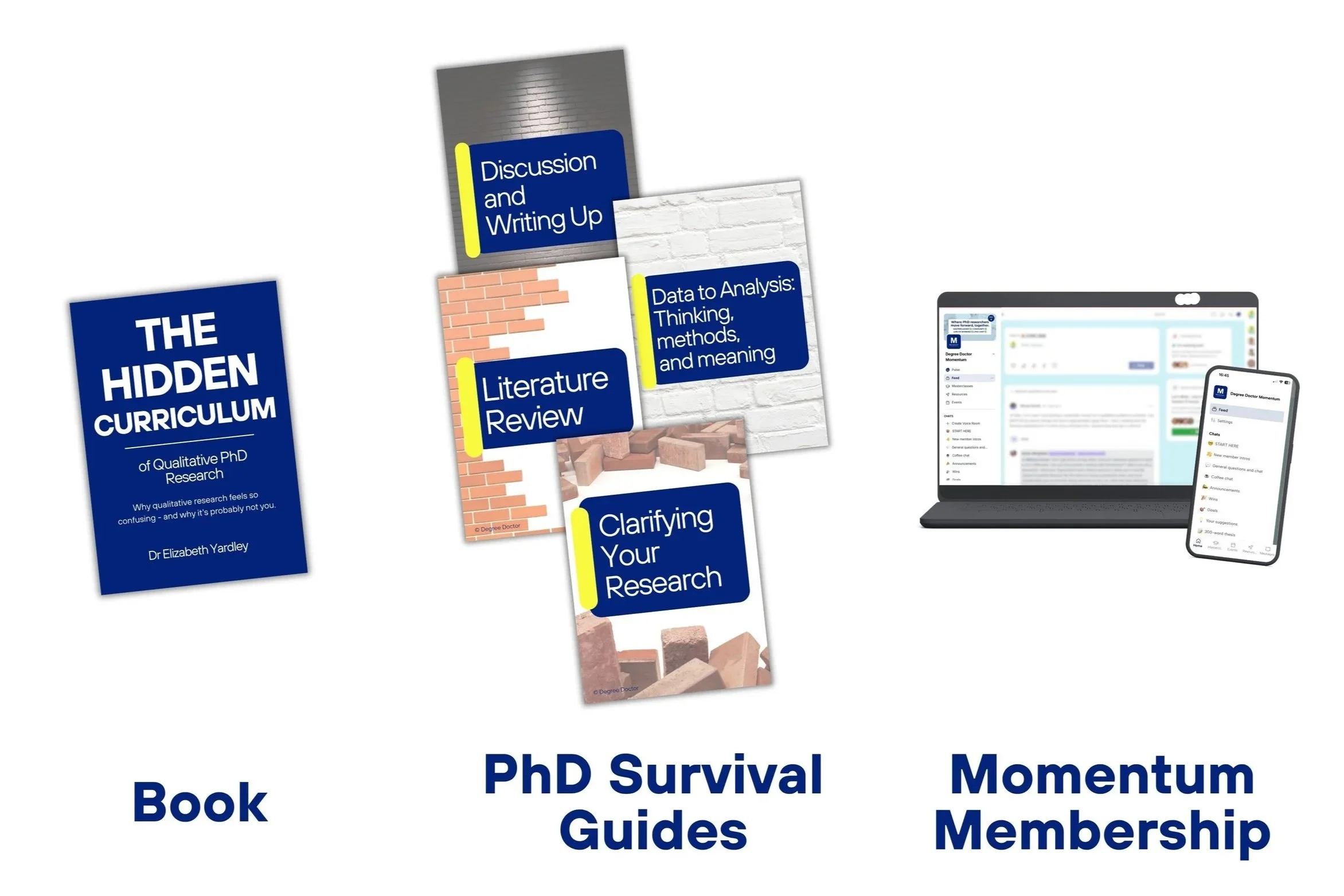
Start with my short book, The Hidden Curriculum of Qualitative PhD Research: Why qualitative research feels so confusing – and why it’s probably not you.

If you’re ready for practical help with the part of your PhD that’s causing problems now, move on to my PhD Survival Guides.


The PhD Survival Guides

I’ve been told that the PhD Survival Guides are like having me sitting next to you as you work on your PhD, pointing you towards the next step, asking the questions you need to keep in mind, and saying, “It’s okay, what you’re worrying about is completely normal!”.

They’re self-study digital guides with worksheets, which you can download and start using today.

They’re very different from any textbooks or doctoral study guides you might already have tried.

That’s because they don’t assume that the qualitative PhD journey is a linear process, where you work on the chapters in the order they appear in your thesis. Most resources that do this end up making you feel terrible about your PhD and I wanted to break that mold!

Here’s the thing:

You will probably rewrite your literature review several times.

You’ll also need to retrospectively stitch it all back together at the end when you realise that the PhD you’ve done wasn’t the PhD you set out to do.

This is all fine and doesn’t mean you got it “wrong” the first time.

The PhD Survival Guides help you navigate this messy journey, whilst getting words on the page that you don’t feel weird about letting your supervisor (or examiner!) see.

Start with the guide that corresponds to what you’re currently working on or buy the Complete System.

Clarifying Your Research. For when you’ve got so tangled up in research questions, concepts and theory that it’s getting hard to explain what you’re actually researching anymore. Get clear on what your PhD is really about and how the main pieces fit together.

Literature Review. For when you’ve read so much but still don’t know how to turn it all into a literature review. Work out what actually belongs, how the literature connects, and what you want to say about it - so you can stop endlessly reading and start writing.

Data to Analysis. For when you’ve got the data, codes or even themes - but you still can’t tell whether your analysis is actually good enough. Learn what strong qualitative analysis looks like, make decisions you can defend, and feel confident standing behind your interpretations.

Discussion and Writing Up. For when you’re close to the end but beginning to doubt absolutely everything. You know what you found, but you’re struggling to explain what it means. Get a clear plan for bringing your findings, literature and theory together - and getting those final chapters written.

The Complete PhD Survival Guide System for Qualitative Researchers. Bring the pieces of your qualitative study together.

The Complete PhD System. When the problem isn’t one chapter - you need to reach into your PhD and connect all the wires together.


About me

I’m Dr Elizabeth Yardley.

For over 20 years, I’ve supported thousands of qualitative PhD researchers through the most complex stages of their doctorate - from early conceptualisation to final write-up.

My work focuses on one thing:

Helping you see what to do next - and trust your judgement as you’re doing it.

Dr Elizabeth Yardley


If you’re tired of doing this all on your own

Momentum

A focused PhD member space with structured resources and weekly sessions to keep you moving.

Learn about Momentum


Further guidance

Blog: Foundational thinking for serious doctoral researchers.

Explore the Blog

YouTube Channel: Clear explanations to orient you before you take action.

Explore YouTube channel